
Outdoor Kitchen Configurator
An outdoor kitchen, designed and priced by the customer
Big Ridge Outdoor Living sells outdoor kitchen islands built to the customer's own dimensions. We built its Kitchen Designer: a three-step tool where a customer picks a layout, enters the run lengths, then designs the island in 3D with real appliances and finishes, watching the price change with every choice. It is live on the Big Ridge store.
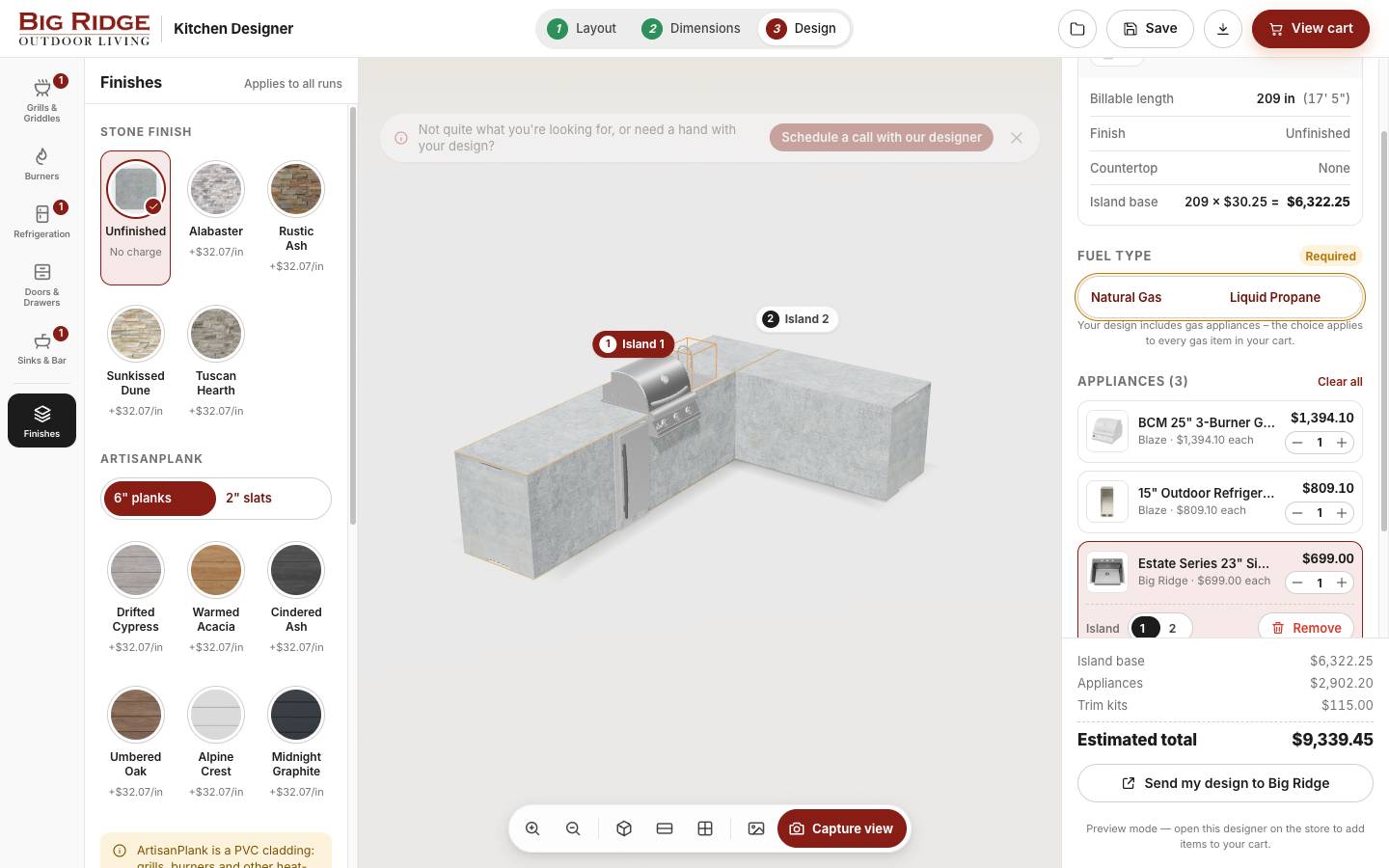
An outdoor kitchen is hard to sell from a product page. The island is built to the customer's own measurements, the appliances come from several brands, and some combinations are not safe to build. Sold by email, that is days of questions before anyone sees a price.
The Kitchen Designer puts the whole conversation in the browser. The customer chooses a shape, types the lengths, and sees their island at once in plan and then in 3D. Every grill, drawer and finish they add changes the total on screen, and the rules that a salesperson would have applied are applied by the tool.
Capabilities
What the Kitchen Designer does
Layout first
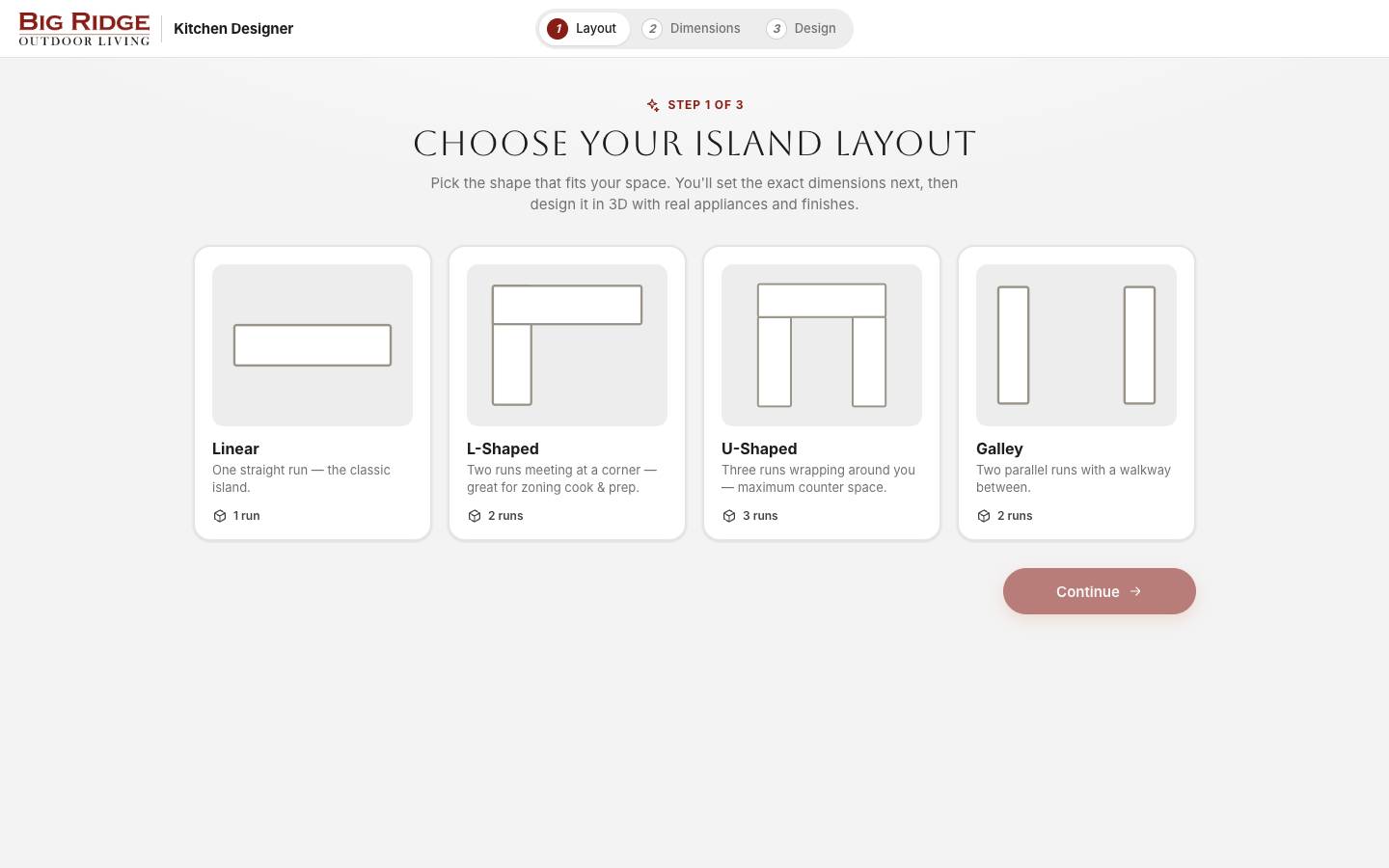
Four island shapes to start from: Linear, L-shaped, U-shaped and Galley. The choice sets how many runs the customer will size and furnish.
Dimensions that price themselves
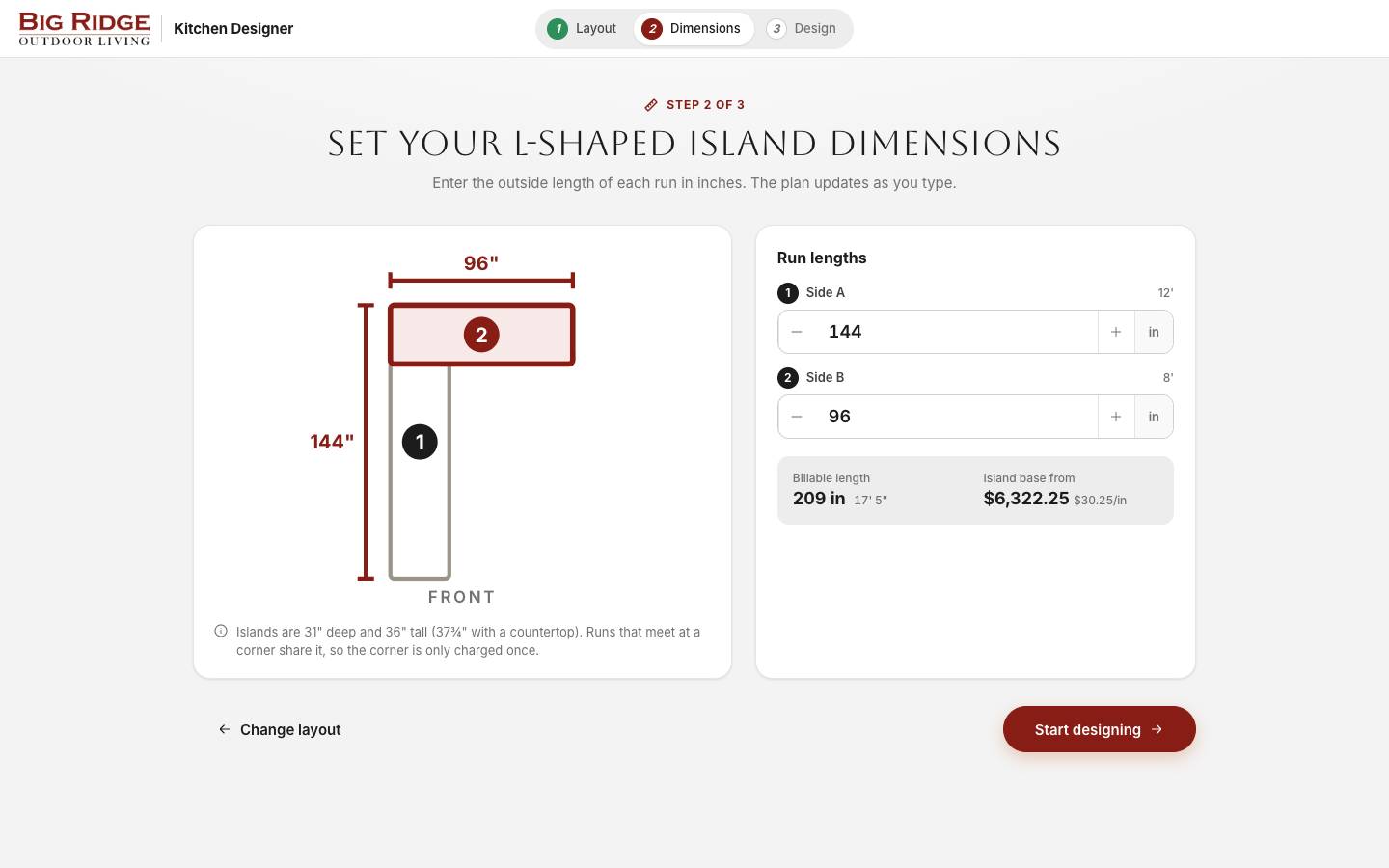
The customer types each run's length in inches and the plan redraws as they type. The tool works out the billable length, counts a shared corner once, and shows the island's base price straight away.
Real appliances, placed in 3D
Grills and griddles, burners, refrigeration, doors and drawers, sinks and bar items come from the store's own catalogue with brand, model number and price. Each one drops onto the island and can be dragged along it.
Finishes that know the rules
Stone finishes and plank cladding are priced per inch. Choose the PVC cladding and the tool adds the insulation jacket that heat-producing appliances need, and blocks any appliance that has no jacket available.
A total that keeps up
Island base, appliances and trim kits add up to an estimated total on screen. Fuel type is asked once and applied to every gas appliance in the design.
From design to order
The finished kitchen goes into the store's cart. Customers can also save a design, share it, capture a view, send it to the Big Ridge team or book a call with a designer.
Step by step
From a blank patio to a priced design
Use cases
Where this kind of configurator fits
Made-to-measure products
Anything priced by length, area or volume: kitchens, wardrobes, decking, worktops.
Catalogues with fitted options
A base product plus appliances, fittings or accessories from several suppliers.
Products with safety rules
Combinations that need an extra component, or that must never be offered.
Online stores
A design that becomes a cart, with every line item priced.
How we deliver
From idea to live on the store
The price list and the rules
We start from how the product is really priced and what may be combined with what.
The 3D library
The base product, appliances and finishes are modelled and optimised for the browser.
The three steps
Layout, dimensions and design are built and tested with real customers' kitchens.
The store
The designer is fitted into the online store, so a design becomes cart items.
After launch
New appliances, finishes and layouts are added to the catalogue as the range changes.
Industries we serve
Technology we use
More configurators
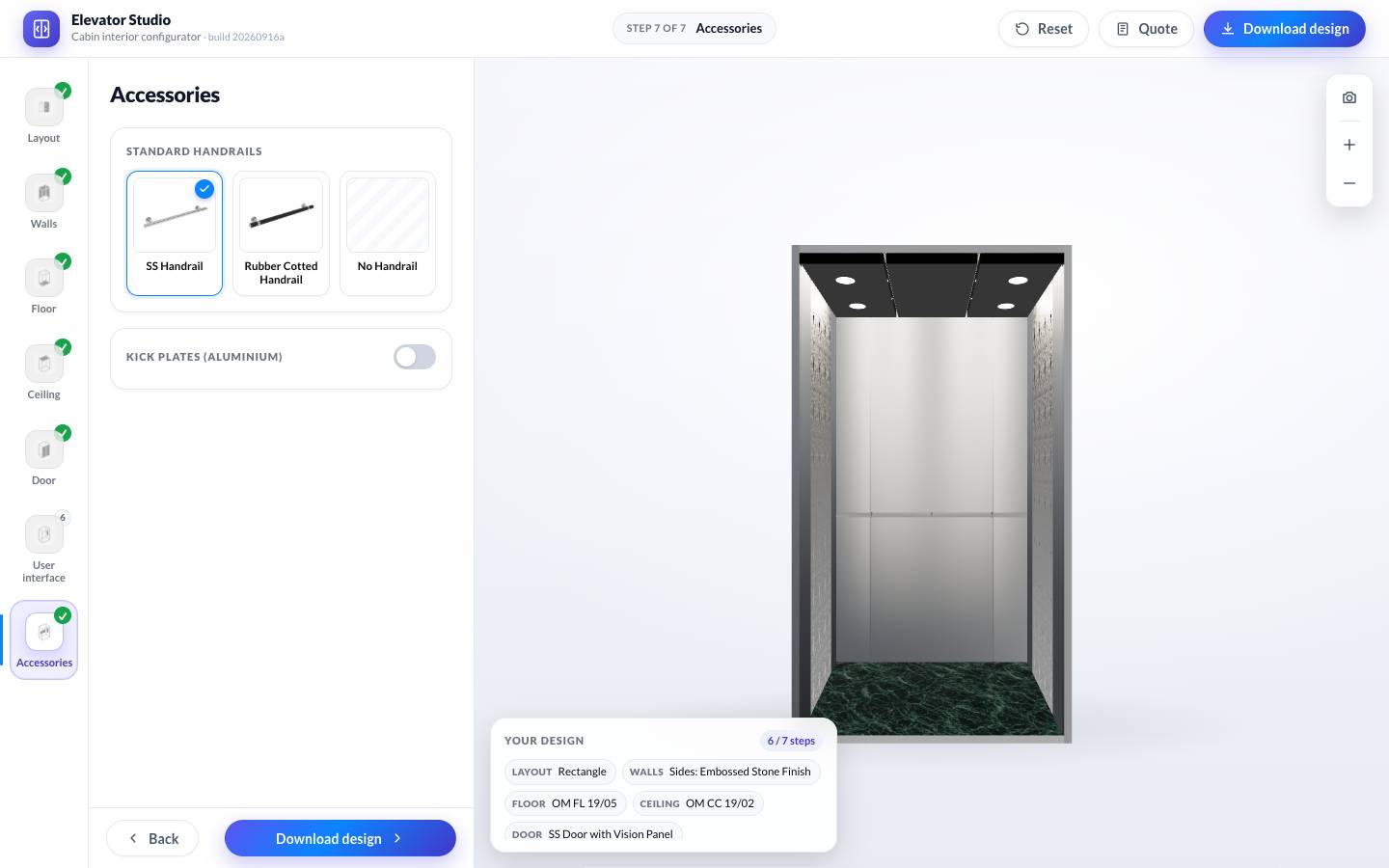
Two more you can open
FAQ
Questions we hear a lot
Where can I try the outdoor kitchen configurator?
It is live on the Big Ridge Outdoor Living store at bigridgeoutdoorkitchens.com, under Outdoor Kitchen Designer. It runs in the browser, with nothing to install.
How does the configurator work out the price?
From the same rules the business uses. The island base is priced per inch of billable length, with a shared corner counted once. Finishes add a per-inch rate. Each appliance carries its catalogue price, and required extras such as trim kits and insulation jackets are added automatically. The estimated total updates with every change.
Can a configurator like this run inside our existing online store?
Yes. This one runs inside the client's Shopify store and hands the finished design to the store's cart. The same approach works with other e-commerce platforms, or with a quote request when the product is not sold online.
How do you stop customers designing something that cannot be built?
The constraints are part of the tool. Run lengths have a minimum and a maximum, and a finish that needs a safety component either gets it added or blocks the appliance that cannot have one. The customer cannot reach an invalid design.
Can you build this for a different product?
Yes. The pattern suits anything sold by dimension and fitted with options: indoor kitchens, wardrobes, modular furniture, decking, sheds, garage systems. We start from your price list and your fitting rules.